November 4, 2026 · Pre-release preview
Grave Seasons Mines Preview: Roguelike Levels, Energy, and Ore
What the November 4, 2026 developer blog confirms about the Grave Seasons mines: generated levels, no enemies, time and energy pressure, rest rooms, and what is still unknown.
Grave Seasons is still unreleased, and the Steam store page continues to list March 9, 2027 as its launch date. On November 4, 2026, Perfect Garbage published a new Steam developer blog titled "Devlog: The Mines!", the most detailed look so far at one of the seven major locations named on the store page. This preview collects what that post and the Steam listing actually confirm about mining, separates it from what has not been explained, and suggests how to prepare for your first trip underground without inventing ore values, floor counts, or drop rates.
Where the mines fit in Ashenridge
The Steam description lists seven major locations: your farm, the Mountainside, the Forest, the Local District, the Commercial District, the Coast and Docks, and the Mines. The same page says you can "fish and mine, discovering new ingredients that will help unravel the mysteries of town." That wording matters. Mining is not presented only as a money system; the store text ties what you find underground to the wider murder mystery. Exactly which ingredients connect to which clue or occult item has not been published, so treat the link as a confirmed theme rather than a recipe list.
For a broader picture of the other regions, the map of Ashenridge page tracks every location the developer has named so far.
Confirmed: the mines are roguelike and generated
The developer blog is direct about the design choice. The team wanted mining to carry risk without turning into a combat zone, and settled on making it a roguelike. Levels are generated through code from hand-made art assets and modular tilesets. Each set of levels has its own group of tiles built around a different visual theme, and simple rules chain corridors and larger chambers together while always preserving the essentials: an escape route and a trapdoor down to the next level.
Obstacles and other surprises on deeper levels are placed using cellular automata, and mineable rocks and forageable items are distributed using loot tables specific to each biome. In practical terms, that means a memorized layout from someone else's video should not be expected to match your own descent. What you can learn ahead of time is the structure the developer described, not a fixed map.
Confirmed: no enemies, but real pressure
One of the clearest statements in the post is that there are no enemies to vanquish in the mines. The team says it decided fairly early that it did not want extensive combat underground. Instead, the post describes the only threat in the mines as your own time and energy, and notes that the time pressure builds as you go deeper.
That fits the rest of the game's structure. The Steam page says you have one year to protect victims from a supernatural serial killer, and that you can stay awake for 24+ hours to experience both day and night in Ashenridge. A long dig is therefore not free. Every hour spent below ground is an hour not spent farming, talking to residents, or watching for the killer. The day and night guide covers what has been confirmed about the clock so far.
What the post does not say is equally important. It does not state what happens if you run out of energy while underground, whether you lose items, or whether you are returned to the farm. Until the released game explains that rule, plan conservatively rather than assuming a soft penalty.
Confirmed: preparation is part of the loop
The developer calls player preparation a core game loop and mentions that some team members have very specific things they buy or craft to keep their energy up before mining. The post does not name those foods or items, and no energy values have been published. The useful takeaway is the habit, not a shopping list: expect to arrive at the mine entrance with supplies chosen in advance, and expect cooking or buying to support longer runs.
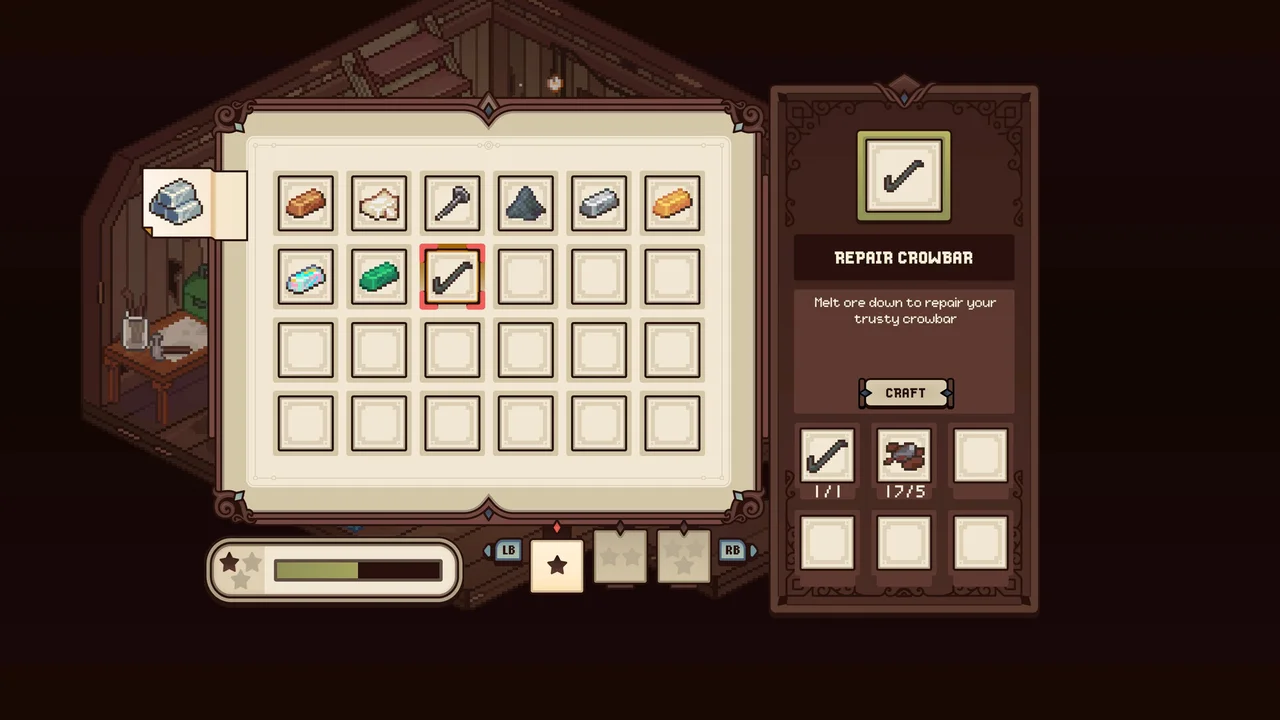
The Steam page confirms that you can craft recipes in your kitchen or your shed and upgrade your tools and farm buildings. One store screenshot also shows a crafting menu with several ore bars and a recipe called "Repair Crowbar" described as melting ore down to repair the crowbar. That is a real interface from the store page, but it does not tell us the full list of ore types, which tool upgrades need which bars, or how often the crowbar needs repairing. Our crowbar and controller preview explains what the team has said about the crowbar itself.
Confirmed: rest rooms between levels
Despite the time pressure, the team describes the mines as designed to be pleasant and peaceful. Memorable waypoints between levels are marked by bespoke rooms where you can breathe, relax, and fish. According to the post, you can return to these rooms at any time. The blog does not say whether they act as save points or shortcuts in the way other farming sims use elevators, so do not assume a specific checkpoint system. It is reasonable, though, to treat each rest room as a natural moment to check the clock and your remaining energy before deciding whether to go further.
Confirmed: the deeper you go, the stranger it gets
The art direction is one of the most specific parts of the blog. The first layers draw on real mine aesthetics, specifically salt mines and overgrown or abandoned mines, before shifting into more natural cave-like structures. Salt was picked for the first layer partly because it allowed an unusual color palette, and the team cites Colombian salt mine cathedrals as an inspiration. The post adds that the art director has a background in geological studies, and that the salt deposits relate to the geology behind the Ashenridge landscape.
Further down, the formations start to break from reality. The developer says you will see more hints at what lies beneath Ashenridge, and that you might find something unusual under the surface. That is a tease, not a disclosure. No pre-release source explains what that something is, whether it is tied to a specific killer, or whether it changes between playthroughs. If you prefer to go in fresh, this is a good place to avoid speculative theories.
Confirmed: music changes with each biome
The audio team wrote a source track for mining before the mines were even implemented, then composed variations for the different biomes so each area feels distinct without drifting too far from the original. The original source track was eventually reused for one of the later biomes. If you follow the score, the soundtrack page covers the earlier music devlog.
What is still unknown
Several questions a mining guide would normally answer have no official answer yet:
- How many levels or biomes the mines contain in total.
- The names, sale prices, or uses of individual ores and gems.
- When the mines unlock, and whether access depends on story progress or a tool.
- What happens when energy runs out underground.
- Whether the active killer or the season changes what you find below. The store page says locations change depending on which killer is active, which residents are alive, and what season it is, but the mining post does not apply that to the mines specifically.
This page will not fill those gaps with guesses. They will be answered once players have the released game.
Other news from the same post
The November 4 blog also mentions that Grave Seasons appeared in the Cozy After Dark showcase, and that IGN shared a video with exclusive gameplay and a conversation between the creative director, narrative director, and Blumhouse Games covering farm upgrades, animals, and mining. The developer adds that Grave Seasons is nominated for Most Anticipated Horror Game in the Horror Game Awards. None of these change the release plan: the post refers to the launch on March 9th, and the Steam listing still shows the game as coming soon with no price displayed. See the release date page for the full timeline.
How to prepare before March 9, 2027
Because the layouts are generated, the most valuable preparation is a routine rather than a route. A sensible launch-day approach, offered as a suggestion rather than a confirmed walkthrough, looks like this:
- Before entering, note the in-game time and your energy, and bring whatever food or supplies the game teaches you restore energy.
- On each level, look for the escape route and the trapdoor first. The developer says both are always preserved.
- Use the rest rooms to decide whether to continue, rather than pushing deeper by default.
- Record the names of new ores and forageables, and which biome they came from, since loot tables are per biome.
- Keep a separate note of anything unusual you find deeper down, and resist linking it to a suspect until the game gives you evidence.
Mining in Grave Seasons sounds less like a combat dungeon and more like a time budget you spend against the one-year clock. That makes it a natural partner to farming and investigation rather than a detour from them. For how those systems connect, read the farming, crafting, and investigation preview, the occult items guide, or browse the full Grave Seasons guide library.